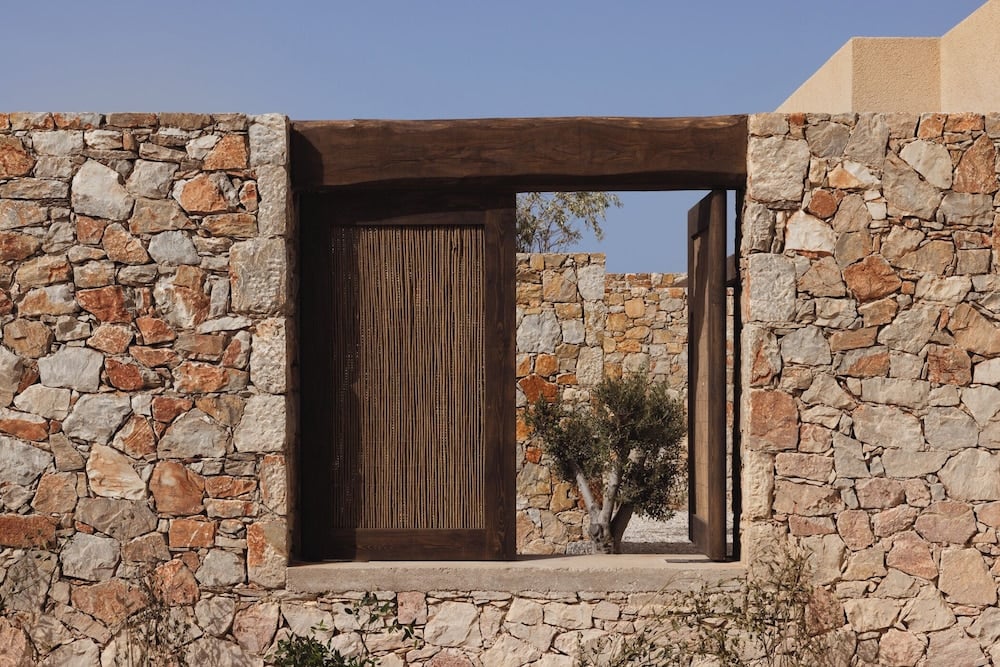
The approach to Gundari is itself a kind of declaration. On the southwestern coast of Folegandros, one of the smallest and least developed islands in the Cyclades, a property carved from volcanic rock emerges as though it has always been part of the cliff face. Conceived by architect Aristide Dallas, the architecture draws from the island's raw geology rather than imposing upon it. Walls of local stone, rammed earth, and rough-hewn concrete step down the hillside in organic, almost geological formations. There are no manicured hedgerows or whitewashed geometries here. Instead, the structures seem excavated from the landscape itself, their interiors opening to uninterrupted views of the Aegean through frameless glass and deep-set apertures that funnel light and wind in equal measure.
The property holds just a handful of suites and villas, each one distinct in layout and orientation, shaped by the specific contours of the terrain beneath it. Accommodations are generous in scale, with natural materials dominating every surface. Expect raw stone floors, linen bedding, and a deliberate absence of ornamentation that lets the land speak for itself. Private terraces extend into the open air, and several suites include plunge pools that seem to dissolve into the sea beyond. The spa draws on the island's mineral-rich environment, offering treatments rooted in simplicity and local botanicals. A saltwater infinity pool, positioned at the edge of the cliff, serves as the social and visual anchor of the property, its stillness broken only by the horizon line where water meets sky.
Dining at Gundari is shaped by the seasons and the surrounding sea. The restaurant sources ingredients from the island's farms and the waters off its coast, presenting a menu that feels instinctive rather than constructed. Meals are served outdoors when weather allows, often with the sound of the Aegean as the only accompaniment. A bar carved into the lower terrace offers wines from small Greek producers alongside cocktails built around regional herbs and citrus. The rhythm of eating and drinking here is unhurried, folded into the broader pace of days spent between water, stone, and sun.
Folegandros itself remains one of the Cyclades' best-kept secrets. The main town of Chora sits on a dramatic cliff edge, its narrow streets and quiet squares largely untouched by the development that has reshaped neighboring islands. There are no cruise ships, no branded storefronts. The beaches are reached by footpath or boat, and the island's interior is a network of old agricultural terraces and hiking trails that wind through wild thyme and dry stone walls. Gundari sits in deliberate conversation with this landscape, a property that does not soften the island's severity but instead finds beauty in its austerity. What stays with you is not comfort in the conventional sense, but the rare sensation of a place where architecture, land, and sea exist in genuine dialogue, and where stillness is not curated but simply the way things are.